Arrival check
When the truck pulls up to the gate, the receiver:
- locates the expected receipt in the system;
- checks that the transport documents match the expected cargo — supplier, carrier, pallet count, seal integrity.
If a mismatch is visible at this stage already (for example, a different supplier or a different carrier), the system lets the receiver log the event and pause receiving until the issue is sorted out.
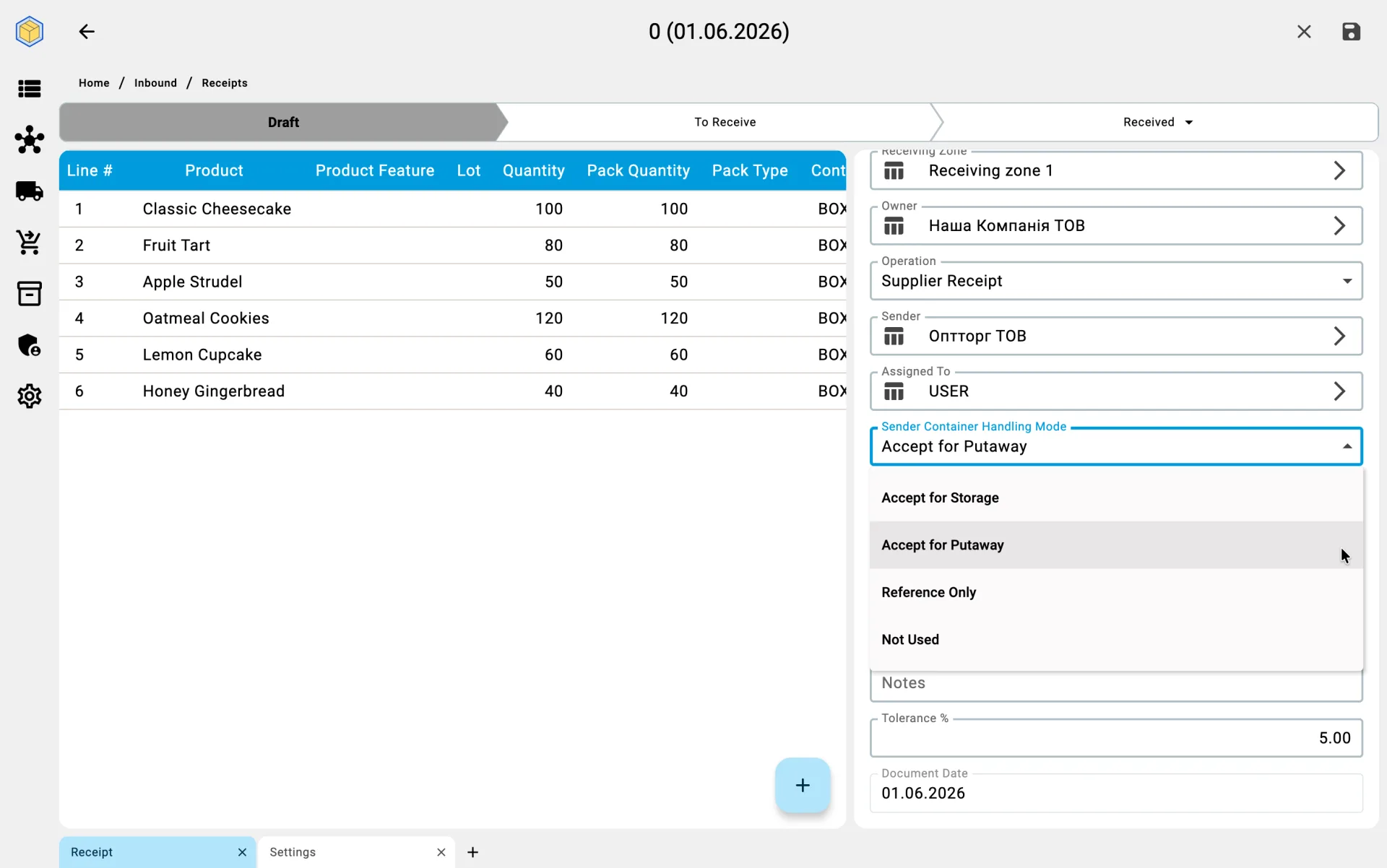
Sender container handling
Sender containers accepted for storage
When the cargo arrives on supplier pallets that will stay on the warehouse as storage units, the receiver additionally checks each pallet for integrity — wrapping, film, labels, seal integrity. Any damage is recorded right away. The pallet count is reconciled against the list of expected pallets that is already in the system.
Sender containers accepted for putaway
When the cargo arrives on supplier pallets that will travel into putaway along with the goods, the receiver checks each pallet for integrity — damaged packaging or broken seals are grounds to halt receiving. The pallet count is reconciled against the list of expected pallets.
Sender containers for tracking only
When supplier containers are used only as a lot identifier — for lookup and reconciliation, not for storage — the receiver records the container numbers. The packaging itself is not accepted onto the warehouse: the goods inside it will be unloaded at the next phase.
Sender containers not used
When the supplier delivers loose goods — bulk or in the carrier's own transport crates — no extra pallet-integrity checks are needed. The receiver focuses on the standard transport documents: supplier, carrier, line count, seals.
On the PDT
This phase happens before the operator picks up the PDT. For how a PDT operator works with the document, see Receiving on PDT.