Adjusting stock and reporting
Approved discrepancies adjust the stock automatically — no manual stock edits are involved.
How the adjustment is recorded
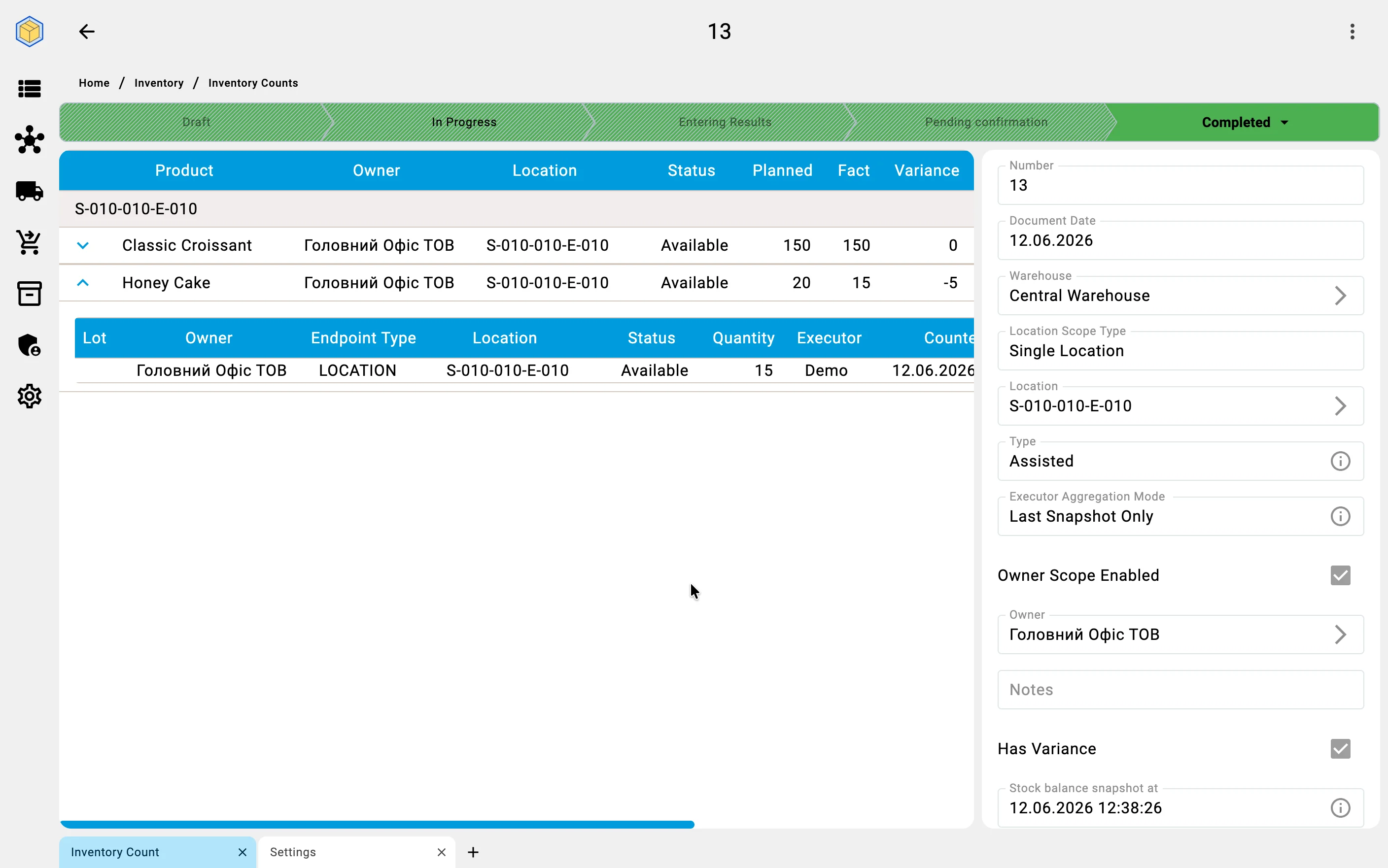
On completion the system settles the final plan-against-fact comparison in one go: every shortage is written off and every surplus is posted. Each correction is a regular stock operation written to the movement journal under the double-entry principle: every entry has a source and a destination, so the sum of all movements always reproduces the current stock exactly. A later audit can therefore trace what changed, when, by whom, and on the basis of which count.
The cells are marked as counted
When the count fully covers its cells — scoped to a single cell or a storage area, with no owner narrowing — completion also sets every covered cell's count status to Count completed («Інвентаризацію завершено») and records the cell's last-count date (see Cell state). These statuses are what cycle counting reads: the last-count date decides when the cell comes round again. (A count narrowed by owner changes no status: it verified part of the cell's stock, not the cell.)
Documents the count produces
When the count closes, the system assembles the paperwork:
- a discrepancy report — the products, the quantities, and the responsible persons;
- adjustment acts for the stock corrections;
- a historical reference kept for later internal and external audits, including tax inspections;
- data handed to the ERP or accounting system through the standard integration.